
Peptide COAs: Why “Third-Party Tested” Isn’t Enough for Patients
- Reclaim Medical R&D

- Jul 27
- 12 min read

Peptide COAs: Why “Third-Party Tested” Isn’t Enough for Patients
A polished certificate of analysis can create instant confidence. The laboratory name looks legitimate, the purity result is 99 percent or higher, and a QR code appears to verify the document. For many people comparing peptide products online, that feels like enough proof to move forward.
It isn’t.
A legitimate certificate of analysis can provide valuable information about a sample tested by a laboratory. It cannot, by itself, establish who manufactured the product, whether the sample represented the full production batch, whether the report applies to current inventory, or whether the vial delivered to a customer came from the tested material.
The document may be authentic while its connection to the product remains unproven. Understanding that distinction is essential when a product is being considered for human use.
What Peptide COAs Actually Prove
A certificate of analysis, commonly called a COA, reports the results of specific tests performed on a submitted sample. Its value depends on the sample, the methods used, the scope of testing, and the records connecting that sample to a finished product.
A peptide COA may identify the compound, report chromatographic purity, measure the amount of active ingredient, or include results for bacterial endotoxin, sterility, residual solvents, heavy metals, water content, or other characteristics. Not every COA includes all of these tests.
The report establishes what the laboratory found in the material it received. It does not automatically establish:
Who manufactured the material
Who selected the sample
Whether the sample represented the entire batch
Whether the seller’s current inventory came from that batch
Whether every vial was filled consistently
Whether the product remained stable during storage and shipping
Whether the customer’s vial matches the lot identified on the report
These questions cannot be answered by a purity percentage alone. They require traceability and a functioning quality system.
How Peptide Testing Works

Different laboratory methods answer different questions. Treating them as interchangeable is one of the most common sources of confusion surrounding peptide COAs.
High-performance liquid chromatography, usually abbreviated HPLC, separates detectable components in a sample. It can estimate how much of the measured chromatographic signal came from the primary compound compared with detectable related substances. A high HPLC purity result can be encouraging, but it does not necessarily establish the total amount of peptide in the vial.
Mass spectrometry evaluates molecular mass and can support the identity of the compound. It helps determine whether the submitted sample has the expected molecular characteristics. It does not prove sterility, accurate filling, proper storage, or freedom from every possible contaminant.
Assay or content testing measures how much active ingredient is present. This is different from chromatographic purity. A vial can contain highly pure material and still contain more or less peptide than the label states.
Sterility testing looks for viable microorganisms under defined test conditions. Bacterial endotoxin testing evaluates inflammatory components associated with certain bacteria. A sample can show no viable microorganisms and still contain measurable endotoxin.
Residual-solvent, heavy-metal, water-content, stability, and particulate testing address other aspects of quality. Each test has a specific purpose, detection limit, and sampling constraint.
A comprehensive quality assessment therefore requires multiple methods. “Tested” does not explain what was tested, how it was tested, or what was never examined.
Why 99 Percent Purity Is Easy to Misunderstand
The phrase “99 percent pure” sounds as though 99 percent of everything inside the vial is the intended peptide. That is not necessarily what the result means.
A chromatographic purity value generally describes the relative proportion of the main detectable chromatographic peak compared with other detected peaks under the conditions of that test. It may not account for water, salts, counterions, residual solvents, excipients, non-detectable contaminants, or the total amount of peptide present.
Consider two hypothetical vials. One contains highly pure peptide but only half the quantity shown on the label. The other contains the labeled quantity but has unacceptable endotoxin levels. Both could still be marketed with an impressive purity result if the seller relies on one narrow test.
Purity is important. It simply is not a substitute for identity, content, sterility, endotoxin control, stability, or fill accuracy.
Batch Traceability Connects the Report to the Product
The most important number on a peptide COA may not be the purity result. It may be the batch or lot number.
A meaningful traceability chain should connect the product through several stages:
The manufacturer assigns a production batch or lot number.
The tested sample is taken from that batch.
The laboratory report identifies the same batch.
The finished product retains that traceable identifier.
The product received by the customer carries a matching number.
If the physical product has no lot number, or its number does not match the report, the connection cannot be verified. The laboratory may have tested something, but the customer cannot establish that the report applies to the vial received.

The age of the report matters as well. A legitimate COA from an earlier production run does not establish the quality of later inventory. Similar labels, identical packaging, or the same product name do not prove that separate shipments originated from the same manufacturing batch.
A QR code can help authenticate a laboratory report. It does not independently prove that the product beside the code came from the tested batch.
What “Third-Party Tested” Really Means
Third-party testing means an outside laboratory performed the analysis. That separation can reduce conflicts associated with unsupported in-house testing, but it does not create an independent sampling program.
In many online peptide transactions, the seller chooses the vial, submits it to the laboratory, selects the tests, and decides which results to publish. The laboratory can accurately analyze the submitted sample without knowing whether it represents hundreds or thousands of other vials.
True independent verification requires more than an outside laboratory. It requires documented sampling, preserved batch identity, appropriate test selection, report authentication, and traceability through distribution.
The words “third-party tested” also say nothing about frequency. A company may test every production batch, periodically test selected batches, or continue displaying one favorable report long after the tested inventory is gone which is often the case.
The phrase is useful only when the seller can explain the complete testing program behind it.
Peptide COAs and Pharmacy Quality Systems Are Not the Same
A COA is a document. A quality system is the operational structure responsible for creating, evaluating, releasing, tracking, and, when necessary, recalling a product.
A functioning pharmaceutical quality system includes qualified suppliers, documented raw-material lots, controlled facilities, trained personnel, established production procedures, representative sampling, appropriate laboratory testing, batch records, quality review, storage controls, complaint handling, distribution records, and recall capability.
Testing is one component of that system. It cannot repair an unsanitary process, correct inaccurate filling, identify mixed inventory after lot numbers have been discarded, or restore a product degraded by improper storage.
This is why a pharmacy-sourced product cannot be meaningfully compared with an unidentified online vial by looking at two purity percentages. The pharmacy pathway includes licensing, records, product labeling, professional accountability, and defined procedures that extend beyond the laboratory report.
The existence of a COA still matters within that system. Federal law requires bulk drug substances used under qualifying 503A and 503B pathways to be accompanied by valid certificates of analysis and manufactured by establishments registered with FDA. The critical difference is that the COA becomes part of a larger documented process instead of serving as the entire quality argument.
How 503A Pharmacies and 503B Outsourcing Facilities Differ
Sections 503A and 503B of the Federal Food, Drug, and Cosmetic Act establish two different pathways for human drug compounding.
A 503A pharmacy is generally a state-licensed pharmacy that compounds medication for an identified patient based on a valid patient-specific prescription. State boards of pharmacy provide primary oversight. Qualifying 503A pharmacies are not required to follow federal current good manufacturing practice regulations, commonly called CGMP.
That does not mean a 503A pharmacy operates without standards. Reputable 503A pharmacies use qualified suppliers, follow applicable pharmacy-compounding standards, maintain dispensing records, label patient products, and implement their own quality procedures. However, their federal regulatory framework differs from that of a 503B facility.
A 503B outsourcing facility is registered with FDA and compounds sterile drugs under the direct supervision of a licensed pharmacist. These facilities must comply with CGMP requirements, report specified adverse events, submit product information to FDA, and undergo FDA inspections according to a risk-based schedule.
Qualifying 503B products also carry required labeling information, including the facility’s identity, the drug’s strength and dosage form, the compounding date, expiration information, and a lot or batch number. That lot number connects the finished product to production records, testing, release decisions, distribution history, and potential recalls.

Compounded medications from either pathway are not FDA-approved products. They do not undergo the same premarket approval process used for conventionally manufactured drugs. FDA registration of a 503B facility means that the facility has entered the federal outsourcing-facility framework and is subject to its requirements. It does not convert each compounded product into an FDA-approved medication.
The practical advantage of the pharmacy pathway is accountability. The source is identifiable, the product is labeled, records are maintained, and a regulatory structure exists when a quality issue must be investigated.
What Research Found in Unregulated Semaglutide Vials
A 2024 peer-reviewed study provides a useful example of why sourcing and traceability matter.
Researchers evaluated online sellers offering semaglutide without a prescription and attempted purchases from six illegal online pharmacies.
Three orders produced no medication and were classified as nondelivery scams.
Three lyophilized semaglutide vial orders arrived and underwent chemical and microbiological testing.
All three delivered vials contained more semaglutide than their labels stated. The measured excess ranged from 28.56 percent to 38.69 percent. All three samples contained detectable bacterial endotoxin. Reported purity ranged from 7.7 percent to 14.37 percent despite manufacturer claims of 99 percent purity.

The samples did not contain viable microorganisms at the time of sterility testing, and the researchers did not identify peptide-like impurities. Those findings are important because they illustrate why test results must be interpreted individually.
A sample can contain the expected compound and show no viable microorganisms while still failing in content accuracy, endotoxin control, purity, labeling, or overall product quality.
The study was intentionally focused on high-risk illegal online sellers and included only three delivered vials. It cannot establish the quality of every research supplier or calculate the failure rate across the entire online peptide market.
What it does establish is that the risk is real. Products sold with professional-looking websites and strong purity claims can differ dramatically from their labels, and some sellers may take payment without delivering anything.
Common Myths About Peptide COAs

Myth: A verified QR code proves the vial is legitimate
A verification link can show that the laboratory issued the report. The vial must still carry a matching batch or lot number, and the seller must preserve the connection between the tested material and current inventory.
Myth: A 99 percent purity result proves the dose is accurate
Purity and quantity are different measurements. A product can have high chromatographic purity while containing too much or too little active ingredient.
Myth: One favorable COA covers every vial with the same label
A report applies to the tested sample and, when properly documented, the production batch it represents. It does not automatically apply to later batches or visually identical inventory.
Myth: Third-party testing proves the sample was independently selected
The laboratory may be independent while the seller controls sample selection. Independent analysis and independent sampling are not the same thing.
Myth: A COA proves a research product is suitable for human use
A research COA can characterize laboratory material. It does not transform that material into medication or establish that it was manufactured, tested, labeled, stored, and distributed for patient use.
Myth: COAs are worthless
A properly authenticated, batch-specific COA can provide meaningful evidence. Its value depends on the methods used, the testing scope, and the traceability connecting the report to the finished product.
Questions Patients Should Ask Before Ordering
Patients should look beyond the words “third-party tested” and ask:
Who manufactured or compounded the product?
Is the source an identifiable U.S. pharmacy or FDA-registered outsourcing facility?
Does the product carry a batch or lot number?
Can that number be connected to manufacturing and testing records?
What testing was performed beyond basic purity?
Was the testing specific to the batch being supplied?
How is the product handled, stored, and shipped?
Who is responsible for complaints, replacement, investigation, and recalls?
Is the product clearly intended and supplied for human use?
A company should be able to explain its sourcing pathway without asking customers to rely entirely on a downloadable PDF.
Reclaim Medical’s Approach to Peptide Sourcing
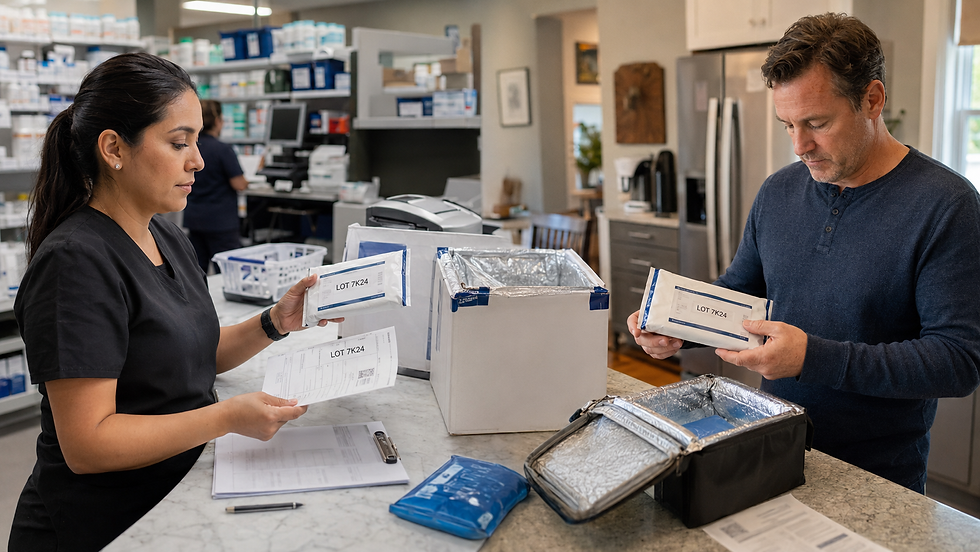
Reclaim Medical provides peptide products through licensed U.S. 503A pharmacies and FDA-registered 503B outsourcing facilities.
That sourcing model provides more than a purity claim. It creates an identifiable chain involving the facility, raw materials, production records, testing, product labeling, lot traceability, fulfillment, and customer support.
This does not make every peptide identical, appropriate for every person, or free from potential risk. Different compounds have different evidence, intended uses, formulations, limitations, and safety considerations.
The point is accountability.
When a product is being supplied for human use, an anonymous vial and a detached laboratory report should not be treated as equivalent to a product supplied through a licensed and regulated U.S. pharmacy pathway.
A COA can support confidence in a tested material. The quality system surrounding the COA determines how much that confidence should extend to the product delivered.
The Bottom Line on Peptide COAs
Peptide COAs are useful, but “third-party tested” should never end the quality discussion.
A meaningful report identifies what was tested, which methods were used, and which production batch the sample represented.
The finished product must retain the same traceable identity. Beyond the report, the source should have documented manufacturing, storage, distribution, support, and recall procedures.
For patients, the most important question is not whether a company can display a COA. It is whether the company can connect the product to an accountable human-use supply chain from manufacturing through delivery.
A laboratory report can describe a sample. A quality system explains why the product in your hand should match it.
References
United States Congress. 21 U.S.C. § 353a: Pharmacy Compounding. Federal Food, Drug, and Cosmetic Act, Section 503A.
United States Congress. 21 U.S.C. § 353b: Outsourcing Facilities. Federal Food, Drug, and Cosmetic Act, Section 503B.
U.S. Food and Drug Administration. FD&C Act Provisions That Apply to Human Drug Compounding.
U.S. Food and Drug Administration. Compounding and the FDA: Questions and Answers.
U.S. Food and Drug Administration. Pharmacy Compounding of Human Drug Products Under Section 503A of the Federal Food, Drug, and Cosmetic Act. Guidance for Industry. Revision 2. June 2016.
U.S. Food and Drug Administration. Bulk Drug Substances Used in Compounding Under Section 503A of the FD&C Act.
U.S. Food and Drug Administration. Information for Outsourcing Facilities.
U.S. Food and Drug Administration. Guidance for Entities Considering Whether to Register as Outsourcing Facilities Under Section 503B of the Federal Food, Drug, and Cosmetic Act. Guidance for Industry. August 2015.
U.S. Food and Drug Administration. Current Good Manufacturing Practice Guidance for Human Drug Compounding Outsourcing Facilities Under Section 503B of the FD&C Act. Revised Draft Guidance.
Electronic Code of Federal Regulations. Title 21, Part 211: Current Good Manufacturing Practice for Finished Pharmaceuticals.
Electronic Code of Federal Regulations. 21 CFR § 211.160: General Requirements for Laboratory Controls.
Electronic Code of Federal Regulations. 21 CFR § 211.165: Testing and Release for Distribution.
Electronic Code of Federal Regulations. 21 CFR § 211.188: Batch Production and Control Records.
Electronic Code of Federal Regulations. 21 CFR § 211.194: Laboratory Records.
United States Pharmacopeia. USP–NF General Chapter 〈71〉: Sterility Tests.
United States Pharmacopeia. USP–NF General Chapter 〈85〉: Bacterial Endotoxins Test.
United States Pharmacopeia. USP–NF General Chapter 〈797〉: Pharmaceutical Compounding, Sterile Preparations.
International Council for Harmonisation. ICH Q7: Good Manufacturing Practice Guide for Active Pharmaceutical Ingredients. November 2000.
U.S. Food and Drug Administration and International Council for Harmonisation. Q2(R2) Validation of Analytical Procedures. Guidance for Industry. March 2024.
U.S. Food and Drug Administration. Analytical Procedures and Methods Validation for Drugs and Biologics. Guidance for Industry. July 2015.
U.S. Food and Drug Administration. Process Validation: General Principles and Practices. Guidance for Industry. January 2011.
Ashraf AR, et al. Multifaceted Assessment of the Quality and Safety of Semaglutide Products Sold by Online Sellers Without a Prescription: Market Surveillance, Content Analysis, and Product Testing. Journal of Medical Internet Research. 2024;26:e65440. doi:10.2196/65440.
Lian W, et al. Evaluation of Peptide and Protein Therapeutic Products by Mass Spectrometry. Journal of the American Society for Mass Spectrometry. 2021;32(8):1852–1860. doi:10.1021/jasms.0c00479.
Zeng K, et al. The Role of Analytical Testing in the Development and Quality Control of Peptide Therapeutics. The AAPS Journal. 2015;17(3):643–651. doi:10.1208/s12248-015-9730-z.
Disclaimer
This article is provided for general educational and informational purposes only. It isn’t medical advice and shouldn’t be used as a substitute for guidance from a licensed healthcare professional. Product quality, appropriateness, risks and individual responses can vary. Compounded medications are not FDA-approved, and the FDA does not verify their safety, effectiveness or quality before they are marketed. Always review questions about medications, ingredients, testing documentation and personal health decisions with a qualified healthcare provider. Availability may vary by product, pharmacy and state.

Comments