
Does HRT Cause Breast Cancer? The FDA Just Rewrote the Warning That Scared Women for 20 Years
- BioBond Labs, LLC
- Aug 17
- 9 min read


Does HRT Cause Breast Cancer? The FDA Just Rewrote the Warning That Scared Women for 20 Years
For more than two decades, women struggling with hot flashes, sleepless nights, painful sex, brain fog, and mood changes have been warned that the treatment most likely to help them might also cause breast cancer.
Many decided it wasn’t worth the risk. Many physicians stopped bringing hormone replacement therapy up at all.
Then, in February 2026, the FDA approved labeling changes removing breast-cancer language from the boxed warnings on the first six updated menopausal hormone therapy products.
So, were women frightened for no reason? Is HRT suddenly considered safe? Or did the FDA simply catch up with evidence that was never as clear-cut as the original warnings made it sound?
The real answer sits somewhere between panic and hype.
Does HRT Cause Breast Cancer?
Not in the simple way the question is usually asked.
Breast cancer develops through genetic changes influenced by age, inherited risk, alcohol use, body composition, breast density, reproductive history, and lifetime hormone exposure. HRT does not suddenly transform healthy breast tissue into cancer.
Hormones can, however, influence the environment in which some breast cancers grow.
Many breast cancers have receptors that respond to estrogen or progesterone. If abnormal hormone-sensitive cells are already present, hormonal stimulation may help them grow and become detectable sooner.
That distinction matters, but it does not make the risk meaningless. A cancer whose growth is accelerated is still a cancer diagnosis.

The bigger problem with asking whether “HRT” causes breast cancer is that HRT isn’t one treatment.
HRT Is Not One Drug

Menopausal hormone therapy may involve estrogen alone, estrogen combined with a progestogen, or low-dose estrogen used only in the vagina. Estrogen can be taken as a pill, absorbed through a patch or gel, or applied locally. Progestogens include both synthetic progestins and micronized progesterone.
These treatments do not share one universal risk profile.
Women who have had a hysterectomy can often use estrogen without a progestogen. Women who still have a uterus generally need adequate progesterone or progestin because systemic estrogen used alone can overstimulate the uterine lining and increase the risk of endometrial cancer.
Adding a progestogen protects the uterus. Unfortunately, the strongest randomized evidence suggests that at least one commonly studied estrogen-progestin combination also increased breast-cancer incidence.
This is why the details matter. The hormone protecting one tissue may affect another tissue differently.
The Study That Changed Everything
Most modern fear surrounding HRT can be traced to the Women’s Health Initiative, or WHI.
The WHI included two large randomized hormone trials. Women with a uterus received conjugated equine estrogen plus the synthetic progestin medroxyprogesterone acetate or a placebo. Women who had undergone a hysterectomy received conjugated equine estrogen alone or a placebo.
In 2002, the combined-therapy trial was stopped early after investigators concluded that the overall balance of risks and benefits was unfavorable.
The news spread quickly.

HRT was linked to breast cancer, heart attacks, strokes, and blood clots. Prescriptions collapsed, and countless women were told to tolerate menopause without treatment.
The safety findings were real, but the public message left out important context.
Participants ranged from 50 to 79 years old, with an average age of approximately 63. Many were well past the beginning of menopause. The study also evaluated specific oral hormone formulations, not every hormone, route, dose, or regimen used today.
The WHI told us something important about those particular treatments in that particular population. It did not prove that every form of HRT was equally dangerous.
What the WHI Actually Found
The two hormone trials produced very different breast-cancer results.

Among women with a uterus, estrogen combined with medroxyprogesterone acetate was associated with more breast-cancer diagnoses than placebo. During long-term follow-up, annualized breast-cancer incidence was 0.45 percent with combined therapy and 0.36 percent with placebo.
That works out to approximately nine additional diagnoses per 10,000 women followed for one year. The increase was real, but the absolute difference was far smaller than the public panic suggested.
The estrogen-only trial told another story.
Among women who had undergone a hysterectomy, estrogen alone was associated with fewer breast-cancer diagnoses and fewer breast-cancer deaths than placebo during long-term follow-up. Annualized incidence was 0.30 percent with estrogen and 0.37 percent with placebo.
That does not prove estrogen prevents breast cancer. The result involved one estrogen formulation in women without a uterus, and observational studies have not always reached the same conclusion. It does prove that “estrogen causes breast cancer” is too simplistic to be scientifically accurate.
The combination matters.
Is Modern HRT Different?

Often, yes. Whether that difference translates into lower breast-cancer risk is harder to prove.
The combined WHI trial used medroxyprogesterone acetate. Many contemporary regimens use micronized progesterone instead. Observational research suggests micronized progesterone may carry less breast-cancer risk than certain synthetic progestins when combined with estrogen.
That is encouraging, but it is not conclusive. We do not yet have a large, long-term randomized trial proving that micronized progesterone eliminates the increased risk seen with older combinations.
The same caution applies to estrogen patches. Transdermal estrogen avoids much of the liver exposure caused by oral estrogen and may carry a lower risk of blood clots for some women. That does not prove a patch eliminates breast-cancer risk.
“Bioidentical” is another word that deserves scrutiny. Some FDA-approved hormones are chemically identical to hormones produced by the body. Compounded products may contain similar ingredients, but they are not FDA-approved and are not held to the same premarket standards for potency, consistency, safety, and effectiveness.
Natural-sounding language is not safety data.
What About Vaginal Estrogen?
Low-dose vaginal estrogen is not the same as systemic HRT.

It is used for vaginal dryness, painful sex, burning, urinary discomfort, and recurrent urinary tract infections associated with menopause. Because it is applied locally, systemic exposure is generally much lower than with estrogen pills, patches, or gels intended to circulate throughout the body.
Large observational studies have not found an increased risk of breast-cancer diagnosis or breast-cancer-specific death among typical users of low-dose vaginal estrogen. Research involving breast-cancer survivors has also been broadly reassuring, although survivors still need individualized guidance, particularly if they are taking an aromatase inhibitor.
For years, vaginal products carried sweeping warnings based largely on studies of systemic therapy. That made two very different types of exposure appear equally dangerous.
They aren’t.
Why the FDA Changed the Warning

The FDA did not announce that HRT can never contribute to breast cancer. It changed how the risk is communicated.
In February 2026, the agency approved updated labeling for the first six menopausal hormone therapy products. References to breast cancer, cardiovascular disease, and probable dementia were removed from the boxed warning, the FDA’s most prominent safety warning.
That language was not simply erased from every systemic product label. Relevant breast-cancer and cardiovascular information remains elsewhere in the prescribing information.
The boxed warning for endometrial cancer also remains on systemic estrogen-only products because estrogen without adequate uterine protection can increase that risk in women who still have a uterus.
The FDA also moved away from the blanket instruction to use the lowest effective dose for the shortest possible time. That does not mean duration is irrelevant. It means an arbitrary slogan should not replace individualized decisions and periodic reevaluation.
The warning changed because it treated different products and different women as though their risks were identical. They are not.
Duration and Personal Risk Still Matter
For combined systemic therapy, breast-cancer risk generally becomes more relevant with longer use. There is no single anniversary when HRT suddenly becomes unsafe, but five months of treatment and 15 years of treatment should not be discussed as if they represent the same exposure.
Personal risk matters just as much.

Age, breast density, alcohol use, obesity after menopause, previous high-risk breast lesions, certain genetic variants, and family history can all change a woman’s baseline risk. A small relative increase means something different for a woman starting at low risk than it does for someone whose risk is already elevated.
Family history does not automatically disqualify a woman from HRT. One relative diagnosed late in life is not equivalent to several close relatives diagnosed young or a known high-risk genetic variant.
A personal history of hormone-sensitive breast cancer is a different situation. Systemic HRT is generally avoided because randomized evidence has raised concern about recurrence.
Women with severe symptoms after breast cancer need an individualized discussion involving clinicians familiar with both menopause treatment and oncology.
Five HRT Myths That Need to Die
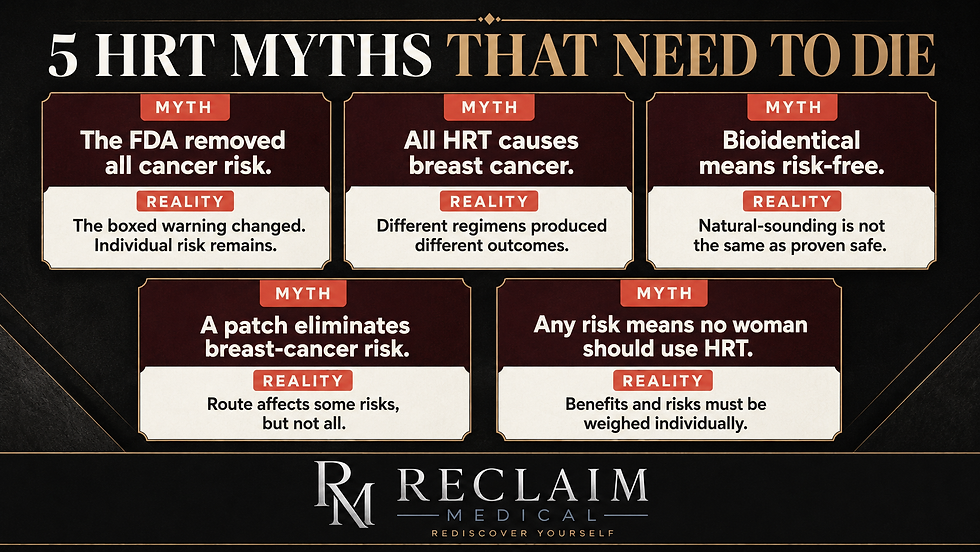
“The FDA removed the warning, so HRT has no cancer risk.”
No. The FDA corrected an overly broad boxed warning. It did not declare every hormone regimen harmless.
“All HRT causes breast cancer.”
No. The best randomized evidence found different outcomes for combined therapy and estrogen alone.
“Bioidentical hormones are completely safe.”
Not proven. A hormone does not become biologically inactive because its chemical structure matches one produced by the body.
“A patch removes the breast-cancer risk.”
Not proven. Patches may offer advantages involving blood-clot risk, but they have not been shown to make breast tissue immune to hormonal effects.
“If HRT carries any risk, no woman should use it.”
That is not how informed medical decisions work. Effective treatments often carry risks. The question is whether the expected benefits outweigh those risks for the individual woman.
So, Should Women Be Afraid of HRT?
No woman should be frightened away from HRT by a warning that ignores her age, symptoms, health history, treatment type, and personal risk.
She also should not be told that modern HRT is completely safe because the old warning was flawed.
The WHI was not worthless. It found that one estrogen-progestin combination increased breast-cancer incidence. It also produced reassuring estrogen-only findings that never received the same attention.
Newer formulations may offer advantages, but some of the confident claims made about them reach beyond the available evidence. Low-dose vaginal estrogen is not equivalent to systemic therapy. A patch is not a force field. Micronized progesterone may be preferable to certain older progestins, but “probably safer” and “proven risk-free” are not the same thing.
HRT is neither poison nor a fountain of youth. It is a powerful and often highly effective treatment whose benefits and risks depend on the woman, the formulation, and the duration of use.
Women deserved that honest explanation 20 years ago. They still deserve it today.
References
U.S. Food and Drug Administration. FDA Approves Labeling Changes to Menopausal Hormone Therapy Products. February 12, 2026.https://www.fda.gov/news-events/press-announcements/fda-approves-labeling-changes-menopausal-hormone-therapy-products
U.S. Food and Drug Administration. FDA Requests Labeling Changes Related to Safety Information to Clarify the Benefit/Risk Considerations for Menopausal Hormone Therapies. November 10, 2025.https://www.fda.gov/drugs/drug-alerts-and-statements/fda-requests-labeling-changes-related-safety-information-clarify-benefitrisk-considerations
Rossouw JE, Anderson GL, Prentice RL, et al. Risks and Benefits of Estrogen Plus Progestin in Healthy Postmenopausal Women: Principal Results From the Women’s Health Initiative Randomized Controlled Trial. JAMA. 2002;288(3):321–333.https://pubmed.ncbi.nlm.nih.gov/12117397/
Chlebowski RT, Anderson GL, Aragaki AK, et al. Association of Menopausal Hormone Therapy With Breast Cancer Incidence and Mortality During Long-Term Follow-up of the Women’s Health Initiative Randomized Clinical Trials. JAMA. 2020;324(4):369–380.https://pubmed.ncbi.nlm.nih.gov/32721007/
Collaborative Group on Hormonal Factors in Breast Cancer. Type and Timing of Menopausal Hormone Therapy and Breast Cancer Risk: Individual Participant Meta-Analysis of the Worldwide Epidemiological Evidence. The Lancet. 2019;394(10204):1159–1168.https://pubmed.ncbi.nlm.nih.gov/31474332/
The North American Menopause Society Advisory Panel. The 2022 Hormone Therapy Position Statement of The North American Menopause Society. Menopause. 2022;29(7):767–794.https://pubmed.ncbi.nlm.nih.gov/35797481/
Fournier A, Berrino F, Clavel-Chapelon F. Unequal Risks for Breast Cancer Associated With Different Hormone Replacement Therapies: Results From the E3N Cohort Study. Breast Cancer Research and Treatment. 2008;107(1):103–111.https://pubmed.ncbi.nlm.nih.gov/17333341/
Asi N, Mohammed K, Haydour Q, et al. Progesterone Versus Synthetic Progestins and the Risk of Breast Cancer: A Systematic Review and Meta-Analysis. Systematic Reviews. 2016;5:121.https://pubmed.ncbi.nlm.nih.gov/27456847/
Vinogradova Y, Coupland C, Hippisley-Cox J. Use of Hormone Replacement Therapy and Risk of Venous Thromboembolism: Nested Case-Control Studies Using the QResearch and CPRD Databases. BMJ. 2019;364:k4810.https://pubmed.ncbi.nlm.nih.gov/30626577/
Bhupathiraju SN, Grodstein F, Stampfer MJ, et al. Vaginal Estrogen Use and Chronic Disease Risk in the Nurses’ Health Study. Menopause. 2019;26(6):603–610.https://pubmed.ncbi.nlm.nih.gov/30562320/
McVicker L, Labeit AM, Coupland CAC, et al. Vaginal Estrogen Therapy Use and Survival in Females With Breast Cancer. JAMA Oncology. 2024;10(1):103–108.https://pubmed.ncbi.nlm.nih.gov/37917089/
Agrawal P, Singh SM, Able C, et al. Safety of Vaginal Estrogen Therapy for Genitourinary Syndrome of Menopause in Women With a History of Breast Cancer. Obstetrics & Gynecology. 2023;142(3):660–668.https://pubmed.ncbi.nlm.nih.gov/37535961/
Holmberg L, Iversen OE, Rudenstam CM, et al. Increased Risk of Recurrence After Hormone Replacement Therapy in Breast Cancer Survivors. Journal of the National Cancer Institute. 2008;100(7):475–482.https://pubmed.ncbi.nlm.nih.gov/18364505/
American College of Obstetricians and Gynecologists. Hormone Therapy for Menopause.https://www.acog.org/womens-health/faqs/hormone-therapy-for-menopause
U.S. Food and Drug Administration. Menopause.https://www.fda.gov/consumers/womens-health-topics/menopause
Disclaimer
This article is for educational and informational purposes only and is not medical advice. Hormone therapy has potential benefits, risks, contraindications, and individual considerations that vary from person to person. Decisions about starting, changing, or stopping hormone therapy should be made with a licensed healthcare provider who can evaluate your symptoms, medical history, cancer risk, current medications, and treatment goals.



Comments